


NAD+ and the cell's power grid: the aging molecule you've never met
NAD+ powers the enzymes that repair your DNA and run your mitochondria — and it falls with age. Here's what the science actually supports.
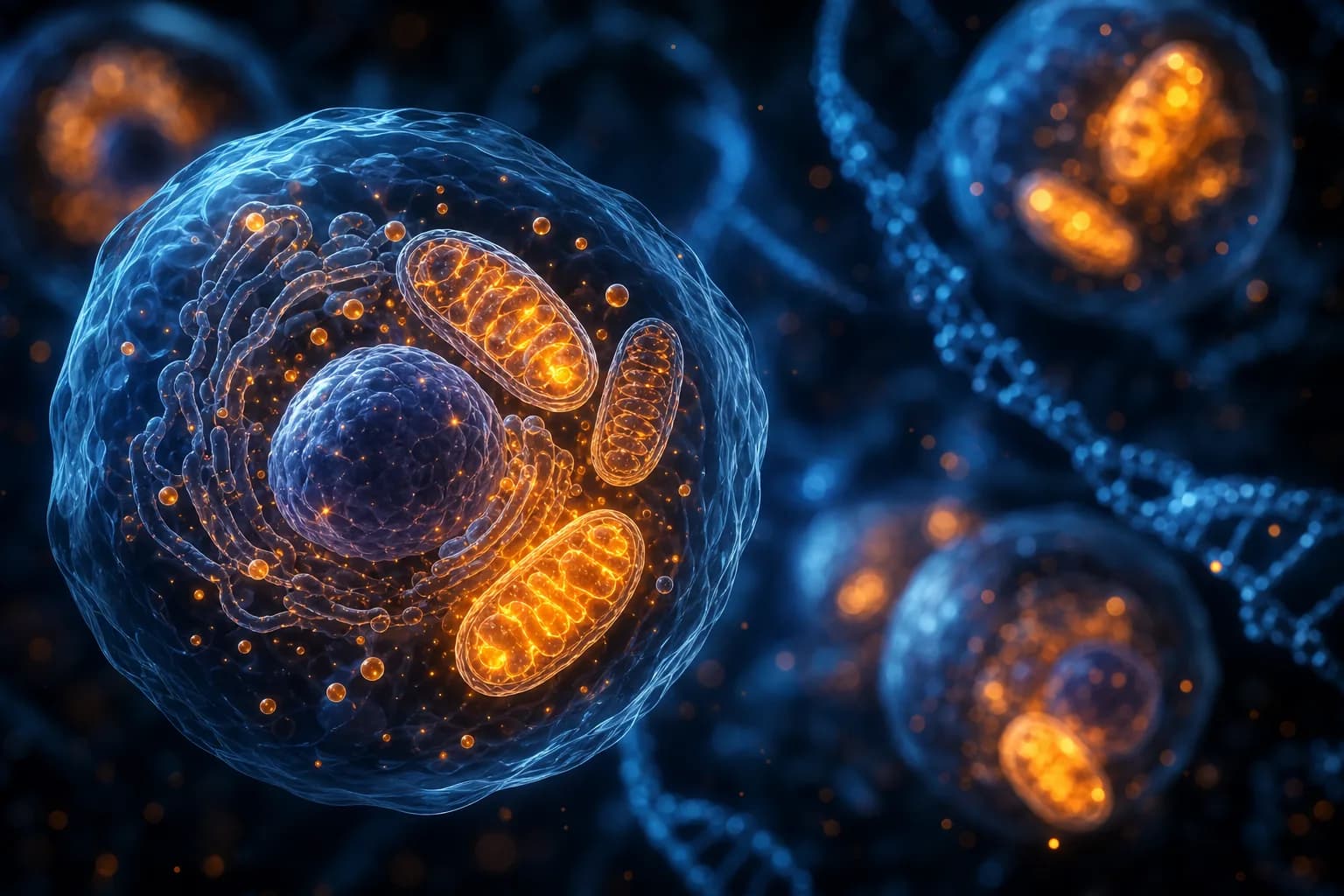
Every cell in your body runs on a molecule most people have never heard of: nicotinamide adenine dinucleotide, or NAD+. It is the currency your mitochondria use to turn food into usable energy, and the fuel for a family of repair enzymes that keep your DNA and cellular housekeeping in order. There is one problem — NAD+ levels decline substantially as we age.
What NAD+ actually does
Think of NAD+ as a rechargeable electron shuttle. It carries the charge that drives ATP production, and it is consumed by two important enzyme families: sirtuins, which regulate how genes involved in stress resistance and metabolism are switched on and off, and PARPs, which respond to DNA damage. When NAD+ is abundant, these systems run smoothly. When it runs low, repair and energy production both suffer.
The age-related decline
Tissue measurements show NAD+ can fall by roughly half between young adulthood and middle age. That decline tracks with reduced mitochondrial function and is one reason researchers studying aging have taken such interest in restoring it. The strategy that has held up best is not supplementing NAD+ directly — it's too large and unstable to absorb well — but supplying precursors the body converts into NAD+, such as nicotinamide riboside (NR) and nicotinamide mononucleotide (NMN).
What the human trials show — and don't
The honest summary: NAD+ precursors reliably raise NAD+ and are well tolerated in trials to date. Downstream clinical benefits — more energy, better metabolic markers, healthier aging — are promising in some studies and mixed in others, and the field is still maturing. The compounds Revivex pairs with NAD+, quercetin and resveratrol, are included because they interact with the same longevity pathways (sirtuin activation and senescent-cell signaling) that make NAD+ interesting in the first place.
Getting the most from an NAD+ protocol
- Consistency beats megadosing — NAD+ turnover is daily, so a steady routine matters more than an occasional large dose.
- Pair it with the levers that raise NAD+ naturally: regular exercise and not eating in a constant surplus.
- Resveratrol is fat-soluble; taking it with a meal that contains some fat improves absorption.
- Give it time — these are maintenance-of-function tools, not stimulants you feel within an hour.
“You can't out-supplement a sedentary life. But if the foundations are in place, restoring NAD+ is one of the more evidence-backed ways to support how cells make and spend energy.”
Revivex Labs
References
- 1.Rajman, L., Chwalek, K. & Sinclair, D. A. Therapeutic potential of NAD-boosting molecules. Cell Metabolism (2018).
- 2.Martens, C. R. et al. Chronic nicotinamide riboside supplementation is well-tolerated and elevates NAD+ in healthy adults. Nature Communications (2018).
- 3.Covarrubias, A. J. et al. NAD+ metabolism and its roles in cellular processes during ageing. Nature Reviews Molecular Cell Biology (2021).
This article is for educational purposes only and is not medical advice. Talk to a qualified healthcare provider before starting any new supplement or protocol.
Keep reading
All articles
Cold, on purpose: what deliberate cold exposure actually does
The science behind why a few minutes in cold water can sharpen your mood, blunt inflammation, and train a more resilient nervous system.
Red light therapy, explained: how photons reach your mitochondria
Photobiomodulation sounds like science fiction, but the mechanism is well defined. Here's how specific wavelengths of light affect skin, muscle, and cells.

The science of better sleep: circadian rhythm, melatonin, and rest that restores
Sleep isn't downtime — it's when your brain clears waste and consolidates memory. Here's what the research says about falling asleep faster and waking rested.